

Persistent trace substances such as PFAS (per- and polyfluoroalkyl substances) and Bisphenol A (BPA) pose a growing challenge for the water industry. They enter the environment through industrial processes, consumer products, and wastewater, where they can persist for long periods.
At the same time, new regulatory requirements are tightening the standards for drinking water treatment and wastewater management. Many existing methods are only partially suitable for efficiently and economically removing these substances.
The project aims to develop a novel system for removing persistent trace substances from water.
At its core is the combination of an innovative filter material with a flexibly deployable reactor system, enabling more efficient removal of PFAS, BPA, and other pollutants than conventional methods.
Fields of Application
- Groundwater remediation:
removal of trace contaminants from contaminated groundwater
Drinking water treatment: removal of PFAS and BPA during raw water treatment - Wastewater treatment plants: integration as a fourth treatment stage for more effective contaminant removal
Project data
Project period: 01 January 2026 – 31 December 2029
Contact: Dr.-Ing. Aron Kneer, Tinnit Technologies GmbH
Funding body: Federal Ministry of Research, Technology and Space (BMFTR)
Technological approach
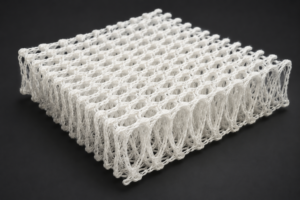
AquaSan uses three-dimensional technical textiles known as spacer fabrics. These textiles are functionalized with a thin layer of activated carbon micro- or nanoparticles. This creates a particularly large active surface on which contaminants can be adsorbed from the water.
At the same time, the open textile structure enables efficient water flow through the material.
Development of a Modular Reactor System
Based on the functionalized textiles, a modular reactor system is being developed.
The system is designed to:
- be flexibly adapted to different applications
- achieve high contaminant removal performance
- be easily expanded or scaled
- enable cost-efficient operation
Advantages of the Textile Adsorber System
- large surface area for effective contaminant adsorption
- low pressure loss during water filtration
- flexible geometry and easy integration into technical systems
- high regenerability and reusability
- excellent scalability for different system sizes
- reduced risk of biological fouling (biofouling)
Testing Under Real-World Conditions
The developed demonstrators will be installed and tested at selected field sites.
Testing under real-world conditions will enable the evaluation of:
- contaminant removal performance
- operational reliability
- economic viability
- maintenance requirements
- long-term performance
This will demonstrate the practical suitability of the system and establish the basis for its future application in the water sector.